
Quality & compliance
Verification you can check yourself
A platform that asks buyers to trust it has to prove more than it promises. This page sets out how suppliers are verified, how quality is controlled, how a lot is traced, and what happens when something is wrong — in enough detail that you can hold us to it.
Supplier verification
Four checks before a supplier can receive a request
- 01
Legal existence
Organisation number confirmed in the Norwegian Register of Business Enterprises, together with registered address, signing authority and whether the company is under any insolvency proceeding.
- 02
Establishment approval
The approval number is checked against the Norwegian Food Safety Authority’s register for the specific site and the specific activity. An approval to process does not imply an approval to export.
- 03
Certificates and scope
Each certificate is checked against the issuing body, and we record its scope and expiry. Scope matters: an ASC certificate covering one farm says nothing about a second one.
- 04
Sanctions and ownership
Company, owners and beneficial owners are screened against applicable sanctions lists before a first trade, and re-screened when ownership changes.
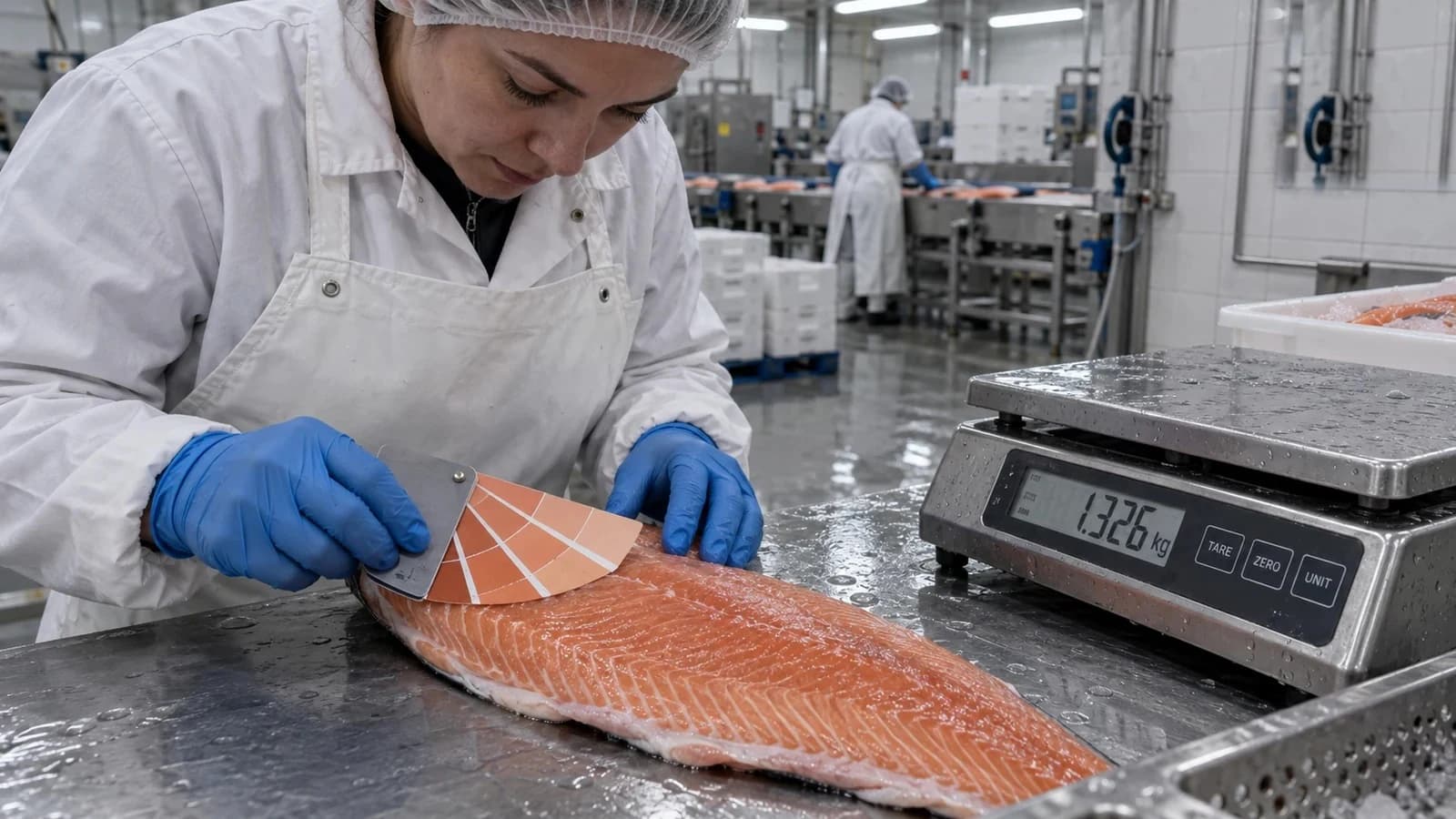
Verification happens at the quay and in the plant, not in a document folder.
Product status
Where a specific lot stands
This is case status, not marketing. It is deliberately kept separate from our service levels and from any official quality grade, so that no one can read a sales tier as a food-safety claim.
- 01
Specification received
The buyer’s requirement is complete enough to source against.
- 02
Documentation verified
Supplier approval, certificates and licences checked against the issuing register.
- 03
Sample approved
The buyer has accepted a physical sample against the written specification.
- 04
Lot inspected
The specific lot has been physically checked before shipment.
- 05
Shipment ready
Documents complete, freight booked, cold chain confirmed.
- 06
Delivered and accepted
Received by the buyer without a registered discrepancy.
Traceability
From lot number back to vessel or site
Every consignment we handle carries a lot number that resolves to a catch or harvest event, a processing site and a date. For wild-caught product that means vessel, catch area and landing date; for farmed product it means site, harvest date and the feed and treatment record where the buyer requires it.
Claims
What happens when something is wrong
- 01
Register within the deadline
A discrepancy is registered against the lot with photographs, temperature log and the weight actually received. Deadlines are short for chilled product and are agreed in the contract, not invented afterwards.
- 02
Assessed against the written specification
We compare what arrived with what was agreed — not with what either party remembers agreeing. This is why the specification is settled in writing before shipment.
- 03
Pursued with the supplier
Where the fault sits with the supplier, we pursue recovery on your behalf and keep you informed of the position rather than going quiet. Where it sits with the carrier, the claim goes to the carrier and their insurer.
- 04
Recorded against supplier performance
Every claim is recorded against the supplier. A pattern changes who receives your future requests, which is the only sanction an agency genuinely has.
Certification landscape
What each certificate covers, and who holds it
Every certificate belongs to a supplier and a production site, never to Fish of Norway. The offer states which supplier and which site each certificate covers, and we check it against the issuing register before the offer reaches you.
First Seafood AS
One of the producers Fish of Norway sources salmon from. Establishment approvals, export registration and product certificates are held by the supplier and its production sites, and are stated per offer.
- Organisation number
- 914 404 908 · Oslo
- Registered activity
- Slaughtering of fish, shellfish and molluscs; freezing and further processing of fish (Enhetsregisteret, NACE 10.202 and 10.203)
- Certificates
- Listed per production site once verified against the issuing register.
MSC
MSC Chain of Custody
Certified sustainable wild fisheries.
ASC
ASC Farm & Chain of Custody
Responsibly farmed seafood.
GGAP
GLOBALG.A.P. Aquaculture
Farm-level good aquaculture practice.
BRCGS
BRCGS Food Safety
GFSI-recognised processing standard.
IFS
IFS Food
GFSI-recognised standard, common in EU retail.
FSSC
FSSC 22000
ISO 22000 based food safety management.
HALAL
Halal certification
Required by several Middle East and Southeast Asia buyers.
KOSHER
Kosher certification
Required by parts of the North American market.
DEBIO
Debio organic
Norwegian organic aquaculture control body.
ESTAB
EU establishment approval number
Mattilsynet-issued approval for export to the EU/EEA.
HEALTH
Health certificate
Per-consignment veterinary certificate.
CATCH
Catch certificate (IUU)
Proof of legal capture for wild-caught consignments.
Roles and responsibilities
Who holds which obligation
Verification reduces risk; it does not eliminate it. A certificate valid on the day we checked can be suspended the week after, and an inspection covers the lot inspected and says nothing about the next one. Fiskeruta AS is the sourcing agent. The producer or exporter of record holds the establishment approval, the export registration and the product certificates, and is named in every offer together with the seller; the buyer is the importer of record. Which party carries which obligation is stated in the transaction contract before anything ships.
Fish of Norway is the trading name of Fiskeruta AS, a Norwegian seafood sourcing agent. Requests are received and handled by Fiskeruta AS; the seller and the exporter of record are named in every offer.
Questions about a specific consignment: sales@fishofnorway.com